Foundation Piers for Denton Houses: Pressed Concrete, Steel or Drilled
Foundation piers carry a dropped part of a house down past the soil that shrinks and swells, to ground that holds still. Every company in Denton sells piers, but not the same kind, and the sales pitch for each type can sound like the only right answer.
Foundation piers in Denton are usually pressed concrete pilings, steel push piers or drilled concrete piers, sometimes with a belled bottom. Fixr (2026) puts piers at $1,000–$3,000 each, whatever the type. The sealed engineer's plan the city requires names the type, count and spacing.
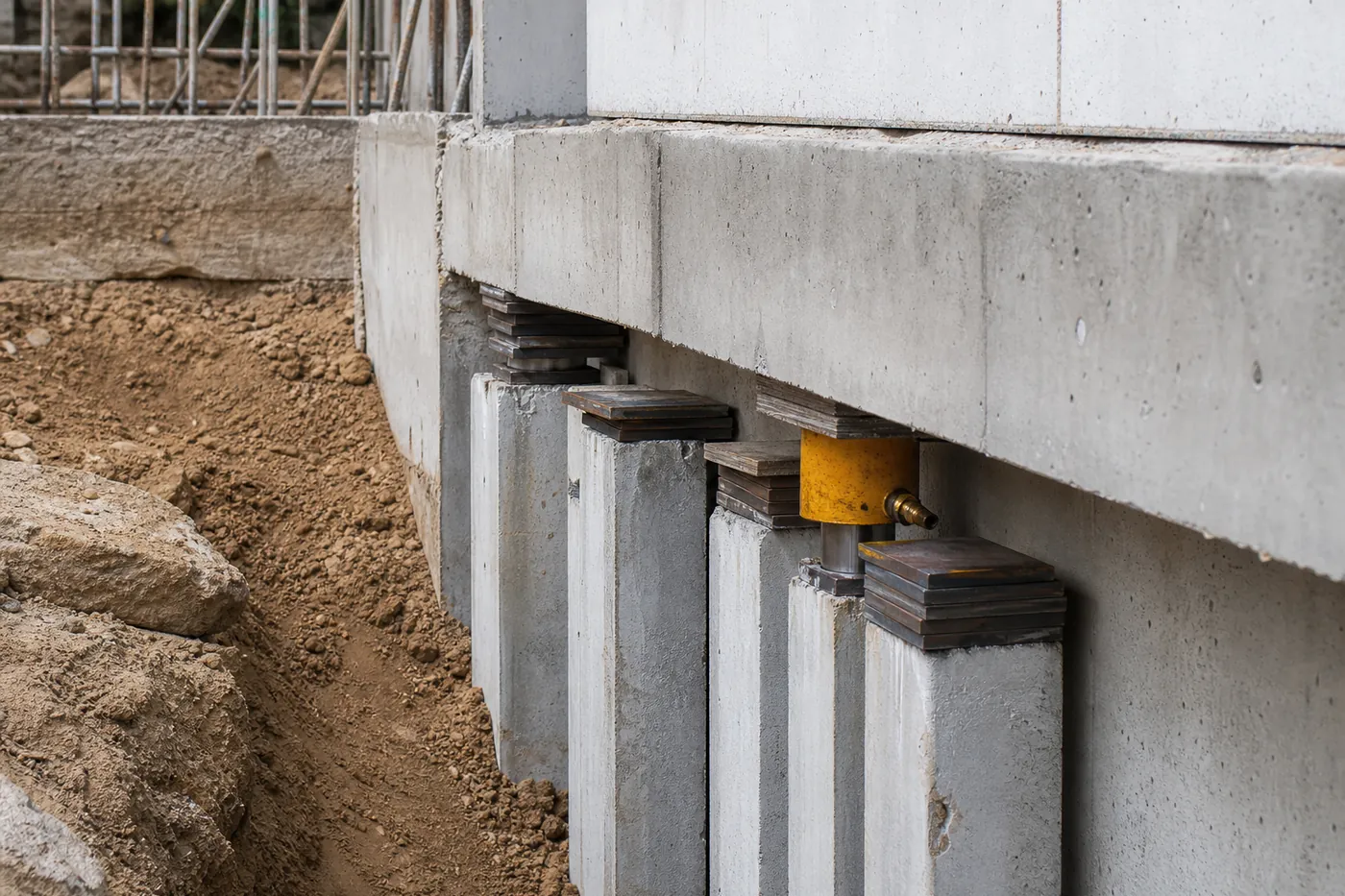
What a foundation pier does under a Denton slab
A slab rests on the top few feet of soil. When that soil dries and shrinks under one edge, the edge drops. A pier goes down through the moving layer, and the slab is jacked up onto it and shimmed. West of downtown, the soils under many streets are Sanger and Medlin clay, both described from fields just south of Denton; each cracks 1 to 3 inches wide and more than 20 inches deep when dry (USDA NRCS). That is the layer a pier has to get past.
The main foundation pier types, side by side
- Pressed concrete pilings. Factory-made concrete segments, each about a foot long, go down one after another under a hydraulic ram that pushes against the slab's edge beam. The house supplies the weight. When the column will not sink any farther, a cap and shims finish it.
- Steel push piers. Lengths of steel pipe are driven through a bracket bolted to the beam, again using the house's weight. Steel sections are slimmer than concrete cylinders and can often be pushed deeper.
- Helical piers. A steel shaft fitted with one or more helix plates is screwed down by a hydraulic drive head. Because the twisting, not the house's weight, sets the depth, helicals often go under porches, additions and other light loads.
- Drilled concrete piers, straight or bell-bottom. A hole is drilled, sometimes widened at the base into a bell, then filled with steel and concrete. The bell spreads the load over more soil. These go to a set depth the engineer chooses rather than to refusal, and they take longer, since concrete has to cure before the house is set on them.
Do east-side and west-side Denton lots need different piers?
Sometimes. Federal soil maps along a line through the city show clay and loam on the west side (Sanger, Ponder, Medlin-Sanger) and sandy East Cross Timbers soils on the east (Birome, Callisburg, Silstid). But Birome, common on the east side, is fine sandy loam for only about 9 inches before it turns to red clay (USDA NRCS), so piers on that side still need to clear a clay layer. A pressed pier stops where resistance builds, which can be shallow in stiff clay; a drilled pier goes where the engineer says. Which one suits a given lot is a soil and engineering question, not a sales one. Compare the full price list in the Denton foundation repair cost guide.
Questions to put to anyone selling foundation piers
- Whose engineer sealed the plan, and can I see the pier layout?
- What stops each pier: refusal under load, or a fixed depth? Will I get the final depths in writing?
- Are any piers inside the house, and who repairs the floor?
- Is the slab post-tensioned, and how will the cables be located before drilling?
- What does the warranty cover: re-adjusting piers, new piers, or only the ones installed? Does it transfer to a buyer?
You can confirm the engineer's license on the public roster of the Texas Board of Professional Engineers and Land Surveyors.
Questions homeowners ask
Are steel piers better than pressed concrete pilings?
Neither is better everywhere. Steel push piers can usually be driven deeper, while pressed concrete pilings are widely used under slabs on clay and often cost less per pier. The deciding factors are the soil under your house and the load, which is why Denton's required engineer's plan, not the sales sheet, should name the pier type.
Tell us about the house
A sentence or two does it: the year the house was built if you know it, and what changed. A garage floor crack that grew, a back door that drags in August, a living room floor that dips toward the middle. One independent foundation specialist who works around Denton reads it and gets in touch.